
Business Systems
37 AI Mistakes Small Businesses Make (Before the Tech Even Matters)
AI fails local companies for the same boring reasons projects always fail: unclear problems, dirty data, no owner, no training, and no patience. Here are 37 mistakes — reordered — with what to do instead.
By Travis Avery · September 23, 2026 · Updated September 23, 2026 · 23 min read
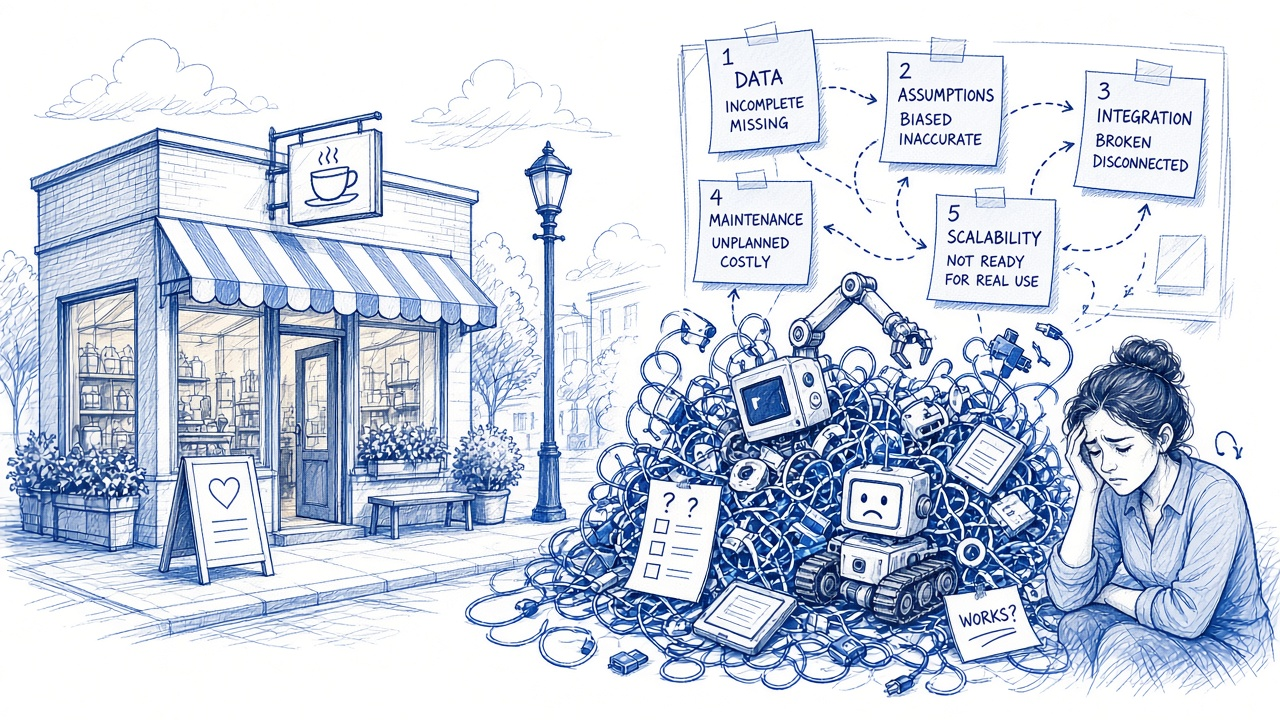
Most HVAC shops, dental offices, salons, and contractors I talk to do not fail at AI because the model is bad. They fail because they skip the boring stuff: a clear problem, clean data, an owner, training, and enough patience to finish the last mile.
This is a field guide, not a shame list. I reordered these on purpose so you do not treat them like a checklist you race through. Use it to pressure-test whatever you are about to buy, build, or hope your team “just figures out.”
If you are still sorting how AI shows up in search and discovery, start with AI search readiness and AEO vs SEO. The ops mistakes below are what trip people up after the headline tools look shiny.
Key takeaways
- Start with a real operational problem, not a vague mandate to add AI.
- Clean data, clear ownership, and simple baselines beat flashy demos every time.
- Train people, govern access, and measure success in your existing KPIs — not vanity AI metrics.
- Treat AI as a multi-year capability across the business, not a one-department IT project.
Mistake 1: Buying AI because everyone else is, not because a problem hurts
“We need AI” is not a strategy. The shops that get hurt are the ones that buy because a competitor posted a demo, a franchisor sent a memo, or a vendor bought lunch. An HVAC company losing after-hours calls, a dental office with no-shows, a salon that cannot fill Tuesday gaps, and a contractor whose estimates sit for a week all have real problems. “Everyone else is doing it” is not one of them.
Name the pain in dollars, hours, or lost jobs before you name a tool. How many calls die in voicemail. How many consults never get a follow-up. How many review replies go out three weeks late. Vendors will happily sell you a solution in search of a problem. Do not let them.
Mistake 2: Jumping into tools before the strategy ties to goals, process, data, and people
Execution without a thin strategy is how a clinic ends up with three chatbots and the same intake form still asking for insurance three times. Tie every AI experiment to a business goal, the process it touches, the data it needs, and who will use it on a Tuesday afternoon. If any of those four is fuzzy, pause.
Strategy here can fit on one page. It just cannot be missing. A plumbing company does not need a transformation deck. It needs one sentence: which goal, which workflow, which records, which person. Skip that and the tool becomes another login nobody opens after the kickoff call.
Mistake 3: Chasing the flashy demo and skipping the unsexy wins
Owners love the booth demo that books appointments with a voice agent. It looks like the future. Meanwhile the unsexy win sits untouched: auto-tagging lead sources in the CRM, summarizing job notes so the next tech is not guessing, or drafting review replies for a human to edit. The voice agent gets the applause. The boring workflow is what actually moves the week.
Ship the boring win first. A dental front desk that stops retyping the same reminder, or a roofer whose office manager stops rewriting every estimate note, will trust the next tool because the first one earned it. That trust, and the time it gives back, funds the flashier step later.
Mistake 4: Running AI with no baseline of how work performs today
If you do not know your current show rate, time-to-quote, or tickets closed per week, you will never know if AI helped. A med spa that “feels busier” and a contractor who “thinks estimates go out faster” are guessing. Guessing is how a failed pilot gets renewed because nobody can prove it failed.
Capture a simple pre-AI baseline for the one workflow you care about. You do not need a data warehouse. A spreadsheet of last month is enough: how long quotes sat, how many no-shows, how many reviews went unanswered. Write the number down before the vendor turns the tool on, so the next conversation stays honest.
Mistake 5: Skipping the data foundation and cleanup
AI amplifies whatever you feed it. Duplicate customer records, an outdated services list, and half-filled job forms produce confident nonsense. A dental practice with three spellings of the same patient, or an HVAC company that lists “AC repair” and “air conditioning repair” as different services, will watch a model repeat that mess in customer-facing text.
Before agents or automations, clean the lists and fields that matter for that one workflow. Not the whole company. The records that workflow actually reads. This is the same discipline behind solid local SEO: messy inputs, messy outputs. If the underlying list is wrong, a smarter model just says the wrong thing faster.
Mistake 6: Automating a function you do not actually understand
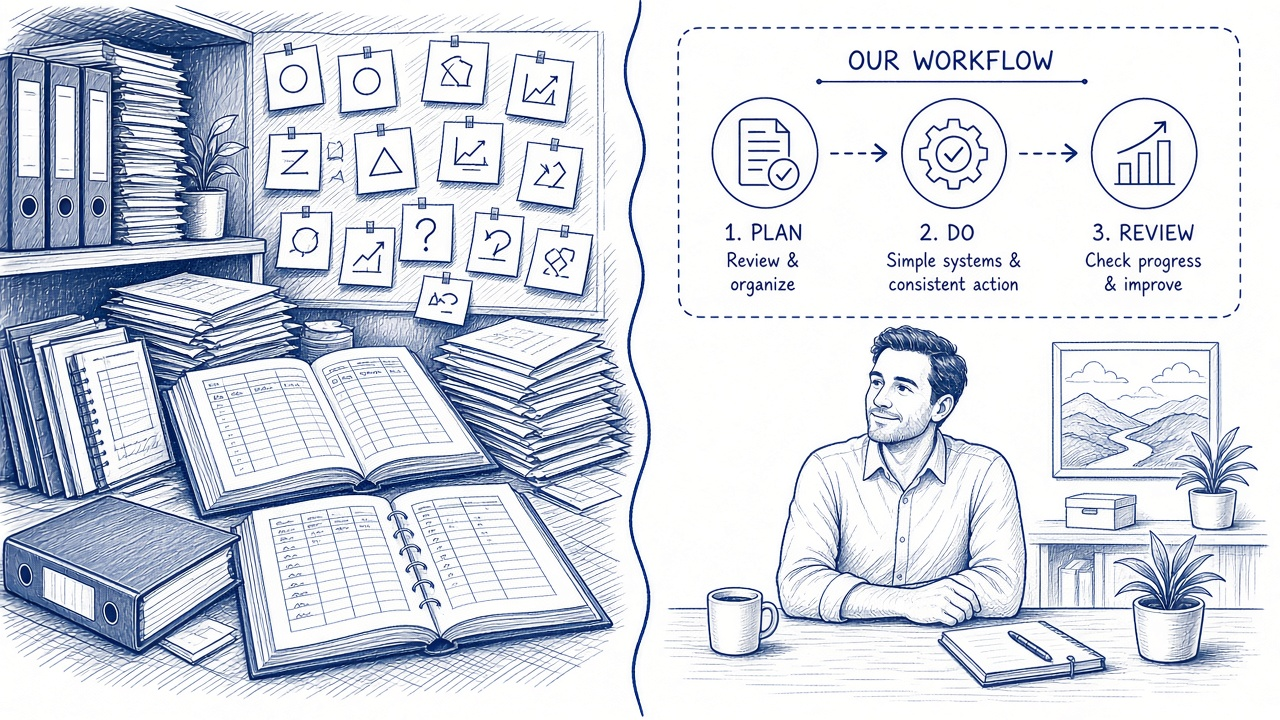
If nobody on your team can walk through how estimates, intake, or scheduling really work — including the exceptions — AI will encode the wrong process at machine speed. The org chart says the office manager owns scheduling. Reality is the tech texting the customer because the status in the system is a lie. Automate the fantasy and you scale the lie.
Map the current workflow with the people who live it: front desk, tech, estimator, office manager. Write the exceptions down. The Saturday emergency. The patient who only wants Dr. Patel. The bid that waits on a supplier callback. Automate only after the map matches that reality.
Mistake 7: Automating the old workflow instead of redesigning it
Pasting AI onto a broken process just makes the broken process faster. A contractor who still passes a quote through five people will get five faster handoffs and the same delay. Ask what should change if a capable assistant were in the loop: fewer handoffs, a status the customer can see, an update that goes out before they call to ask.
Sometimes the win is removing steps, not wrapping them in a chatbot. If the estimate already has the scope, the price, and the next date, stop routing it through a shared inbox “so everyone is in the loop.” Fix the path, then decide whether a model belongs on it at all.
Mistake 8: Over-engineering AI when plain software would do
Not every problem needs a model. A salon reminder sequence, a missed-call text, and a form that actually captures the service requested are often rules, templates, and ordinary glue. Reach for AI when the hard part is language, judgment under ambiguity, or spotting a pattern a checklist will miss. Reach for normal software when the path is already clear.
A clinic explaining a coverage question in plain English might need a model. A plumber confirming “we will be there between 1 and 3” does not. Custom agents are expensive to babysit. If a better form or a saved reply would have solved it, you bought a research project.
Mistake 9: Underestimating how hard systems have to talk to each other
Your scheduling tool, CRM, SMS platform, and invoice system were not designed to be one brain. This is where timelines slip for contractors and clinics alike. The dispatch board says the job is done. QuickBooks still shows it open. The customer got a text about a different appointment. None of those tools think that is their bug.
Budget time for connectors, field mapping, and failure modes — or keep the first AI use case inside one system on purpose. A single inbox assistant that drafts replies is a smaller promise than an agent that books, invoices, and updates the crew. Start where the data already lives. Add a second system only after the first one fails in a way you can see.
Mistake 10: Locking the whole company into a single AI provider
One vendor is convenient until pricing changes, quality dips, or a better model shows up for your niche. A dental group that signs a three-year exclusive before the scribe has survived a real Monday owns that decision for longer than the tool may deserve. Prefer setups where prompts, data, and workflows can move.
For a small team, that means starting light. Avoid multi-year exclusivity before you know what works. Keep a copy of the prompts, the field list, and the examples that make output acceptable. If you cannot leave without rebuilding the business, you did not buy software. You hired a landlord.
Mistake 11: Giving staff a chat box with no access to the systems that matter
A generic chat window that cannot see jobs, inventory, or customer history is a toy. The receptionist asks it when Mrs. Nguyen is due and it invents an answer, or it tells her to check the other system — which is what she was already doing. Useful AI for local ops needs governed access to the tools the work lives in: appointments, tickets, documents, with clear limits.
Chat alone trains people to copy-paste and hope. If the model cannot read the job, do not put it in front of the person who answers the phone. Give it the record it needs, or keep it on internal drafts where a wrong guess is cheap.
Mistake 12: Skipping permissions and role-based access before you let agents loose
Agents that can read everything and write everywhere are a liability. A salon assistant that can see color formulas, payment cards, and every client’s notes will eventually send the wrong detail to the wrong person. Set who can see what, and what an automation is allowed to change, before you scale past a pilot.
Permissioning is not bureaucracy. It is how you sleep after the first agent emails the wrong customer. The front desk does not need payroll. The model drafting review replies does not need the ability to issue refunds. Least access for one job, then widen only when the audit trail has earned it.
Mistake 13: Obsessing over cost before you know the idea is feasible
Penny-pinching on tokens while the workflow is still undefined wastes more money than a short, paid pilot. A contractor who argues about API price before anyone has run last week’s leads through the follow-up draft is optimizing a process that may not work. Feasibility before frugality.
Prove the process on a small slice of real work first. Ten estimates. One week’s missed calls. A handful of review replies. Then look at spend. A cheap tool that nobody can finish is more expensive than a paid week that tells you to stop.
Mistake 14: Turning AI into a headcount conversation before the work is clear
“This will replace two people” is a poor opening move and a worse success metric. Say it in a staff meeting at a clinic and you have just trained the front desk to hide problems from the tool. For most shops, early AI is fewer dropped balls, faster follow-up, and more consistent work — not a layoff spreadsheet.
Talk ROI after the workflow is stable enough to measure. Reducing AI to headcount too early kills learning and trust. People will not show you where the model fails if they think the next success is their job. Get the work clear. Then decide what the hours are worth.
Mistake 15: Inventing shiny new AI KPIs instead of accelerating the ones you already run
If your business already tracks close rate, average ticket, time-to-book, or review response time, let AI serve those numbers. A med spa dashboard full of “AI interactions” impresses nobody who pays rent. The owner still needs to know whether consults got booked and whether the reply went out the same day.
Accelerate existing KPIs. Do not invent a parallel scoreboard. If the number you already run did not move, the project did not work, no matter how many chats the vendor reports. Pick the one metric the workflow was supposed to change and keep it on the same sheet you used before the tool arrived.
Mistake 16: Ignoring internal evaluations and cost per successful task
Ship something that “usually works” and you will quietly bleed money on retries, corrections, and staff cleanup. An HVAC dispatcher who rewrites every AI job note is not saving time. They are paying for a draft and then doing the job anyway. Define what a successful task looks like before you scale it.
Sample outputs on a schedule. Watch cost per success, not just the monthly API bill. A cheap model that is wrong half the time is still expensive once you add the human who fixes it. If you cannot say what “done and usable” means for that task, you cannot tell whether the tool is earning its keep.
Mistake 17: Shipping the demo, then declaring victory
A polished Friday demo is not a live process. The gap between “it worked once on stage” and “it works every Tuesday with real customers” is where these projects die. The dental reminder that sounded perfect in the conference room double-books Monday morning because nobody watched the exceptions.
Plan for monitoring, a handoff when the AI fails, and a human who owns the outcome after launch day. Name that person before you celebrate. If the only success criterion was the demo, the project ended at the demo.
Mistake 18: Tolerating AI slop in customer-facing work
Drafts that sound generic, get details wrong, or feel like every other business erode trust fast. A roofing reply that could belong to any roofer in the state, or a dental page that invents a service you do not offer, is not a time-saver. It is a reason to call someone else. Especially on your website and review replies — the same surfaces that already decide whether you lose customers — edit hard.
AI can draft. Your standards decide what ships. If a sentence would embarrass the owner when a neighbor reads it, it does not go out. Give the editor a short list of facts that must be true: service area, hours, what you do not do, and the next step. Slop is a publishing choice.
Mistake 19: Pushing AI on the team without depth or training
A login and a pep talk are not enablement. The tech who was told to “just try it” will try it once, get a wrong parts list, and go back to the notebook. Show people good examples from your business, where judgment still matters, and how to spot bad output. A salon color note and a clinic after-visit summary do not fail in the same way.
Short, repeated practice beats a one-time webinar nobody remembers. Ten minutes in the weekly huddle, on real work, with someone who can say “that answer is wrong because we do not offer that.” Training is the product. The license is just the entry fee.
Mistake 20: Underestimating change management
New tools rearrange habits, status, and fear. Front-desk staff, techs, and managers need time, clarity, and a place to escalate issues. The office manager who quietly keeps the old spreadsheet is not being difficult. The new intake made her slower, and nobody asked.
If you only budget for software and not for coaching through the messy middle, adoption stalls even when the tech works. Tell people what changes this month, what stays the same, and who to tell when the tool is wrong. Then leave room in the schedule for that conversation. Change is part of the implementation, not a speech you give at the start.
Mistake 21: Promising people that AI will not change anyone’s job
Everyone can tell when that line is marketing. Be honest: some tasks will shrink, some will grow, and roles will shift toward review, exceptions, and customer care. A billing coordinator who used to type every line may spend the hour checking a draft instead. Pretending otherwise makes the honest version sound like a surprise later.
Clarity builds more loyalty than false comfort. Pair the honesty with a training path so people see a future, not a cliff. Say which tasks you expect to change in the next quarter, and what “good” looks like in the new version of the job. Staff can handle a shift. They cannot handle a promise you already broke.
Mistake 22: Leaving no safe place to ask questions or share what works
When AI questions feel like admitting weakness, people invent private workarounds. The tech who found a prompt that summarizes job notes never tells the other crews. The front desk pastes patient details into a personal account because asking for help feels like failing the new initiative.
Create a simple channel or a weekly huddle where staff can share prompts, failures, and wins without a performance review attached. Shared learning compounds. Silent struggle becomes shadow process, and shadow process is how bad output reaches a customer with nobody accountable for it.
Mistake 23: Never blocking real time to experiment
If experimentation only happens after 9 p.m., it will not happen. The office manager of a plumbing company already owns the phones, the schedule, and the angry customer. She is not going to invent your AI workflow after close. Give a named owner a few protected hours each week for trials on real, low-risk work.
Dedicated time is cheaper than another unused subscription. Put it on the calendar the way you would a vendor meeting, and judge it by what got tried — not by a slide. Curiosity without hours is a wish.
Mistake 24: Overprotecting data and spend until nobody can learn
Security and budget matter. Zero experiments also matter: they guarantee you learn nothing while a competitor down the street tries a narrow pilot. The answer is not “paste the full customer list into a consumer chatbot.” It is also not a ban so complete that the only learning happens off the books.
Carve a governed sandbox. Limited data, limited spend, clear rules about what must never leave the building: payment cards, full medical notes, anything you would not hand a new hire on day one. Protect the business without smothering the only people curious enough to find a useful workflow.
Mistake 25: Offering no governed path for non-technical builders
Your office manager or ops lead often sees the best automations first. They know which reminder actually gets a patient to confirm, and which estimate follow-up sounds like a robot. If the only options are “wait for IT” or “build it in a personal ChatGPT account,” you lose either speed or control.
Give non-technical builders approved tools, a few templates, and a light review path. Someone should see the workflow before it emails customers. That review can be fifteen minutes. The point is a door they are allowed to walk through, instead of a choice between a ticket that never moves and a workaround you cannot see.
Mistake 26: Starving the center of excellence until shadow AI takes over
An “AI team” with no time, no backlog discipline, and no authority becomes a suggestion box. Meanwhile staff buy random tools on personal cards. Three salon locations end up with three chatbots, three bills, and three versions of your hours. Nobody picked that architecture. It arrived because the coordinating seat was empty.
Resource the function lightly but clearly. Even one part-time owner with a prioritized list is enough to keep shadow AI from becoming the default. Their job is not to build everything. It is to say what is approved, what is next, and what has to stop.
Mistake 27: Assuming one heroic person “owns AI” for the whole company
One enthusiast cannot be strategy, builder, trainer, and night-shift firefighter forever. In a lot of local companies that person is the owner’s kid, the office manager, or the one tech who “knows computers.” They will carry it until they burn out or leave, and the workflows leave with them.
Spread ownership. An executive sponsor who can kill a bad project. A process owner who lives the workflow. People who maintain the prompts and the exceptions after launch week. Hero models burn out. Systems last because more than one person can explain them.
Mistake 28: Letting one department own AI as a vertical silo
When only marketing or only IT “does AI,” every other function stays stuck. Marketing has a bot that writes posts. Dispatch still runs on a whiteboard. The patient reminder and the unpaid-invoice follow-up never get a turn because they are nobody’s experiment.
Local businesses win when AI is horizontal — scheduling, service, finance follow-up, reviews — with shared standards for what can be sent and what must be checked. Cross-team use cases beat turf wars. The standard should be boring and shared: which data, which approver, which metric. The department that bought the first license does not get to own the rest of the company.
Mistake 29: Running AI like a pure IT project with no executive owner
Tickets and sprints without a business owner produce tools nobody asked for. A clinic ticket that says “add AI” will come back as a chatbot on the homepage while missed-call follow-up is still a sticky note. IT can enable the system. IT cannot decide which leak is worth fixing this quarter.
An owner at the leadership level sets priorities, resolves tradeoffs, and kills vanity work. That person does not have to configure the tool. They do have to say which outcome matters and which project is done. If nobody in leadership will own the result, do not start the build.
Mistake 30: Leaders who will not drive AI — or cannot say what good looks like
If the owner or GM treats AI as someone else’s hobby, the team will too. The tool gets bought, the login gets forwarded, and six weeks later nobody can say whether it helped. Leaders do not need to write prompts daily. They do need to demand clarity: which problems, which metrics, which standards.
You cannot enforce what you refuse to understand at a basic level. You should be able to look at a customer-facing draft and say whether it sounds like your shop. If the only person who can tell “good” from “plausible” is the vendor, you do not have a standard. You have a subscription.
Mistake 31: Leaving Legal, Finance, and IT out until something breaks
Even small companies have consent issues, payment data, and vendor contracts. A med spa pasting treatment notes into a consumer chatbot, or a contractor dropping card numbers into a prompt “just to draft the invoice email,” is a rebuild waiting to happen. Bring the relevant voices in early: your accountant, counsel on retainer, whoever already manages the systems.
You do not need a committee. You need the person who will be angry later to be slightly annoyed now. Early friction is cheaper than public cleanup, a contract you cannot exit, or a customer who finds their details in a place you did not mean to put them.
Mistake 32: Failing the last mile across governance, data, people, and process
Most AI efforts stall in the last mile. Unclear who approves outputs. A data feed that went stale in March. Staff who were trained once. A process that still needs five manual steps after the “automation.” The estimate bot drafts a beautiful scope and then sits in an inbox nobody checks. That is not a launch. It is a prop.
Finish governance, data, people, and process on purpose. A half-deployed assistant is worse than no assistant because it trains everyone to ignore it. If you cannot name the approver, the source of the data, the person who was trained, and the step that still happens by hand, you are not at the last mile. You have not started it.
Mistake 33: Outsourcing your thinking to the model
AI is a force multiplier for judgment you already have. It is not a substitute for it. Blind trust wastes tokens and ships bad calls. A contractor who accepts an AI scope that missed a permit, or a clinic that sends an after-visit note nobody read, did not save time. They moved the mistake closer to the customer.
Use it to draft, summarize, and explore. Then apply your shop’s standards. If you would not let a new hire send it unsupervised, do not let the model send it unsupervised. Bad judgment plus a fast model just fails faster, in more places, with a tone that sounds sure of itself.
Mistake 34: Running on FOMO with no multi-year patience
The tool landscape will keep shifting. Local businesses that win treat AI as a capability they grow over years: small releases, measured learning, steady training. The shop on its third “AI platform” this year, with nothing in production, does not have a roadmap. It has a panic.
Panic-buying every new feature is not a plan. Patience is a competitive advantage when peers churn tools quarterly. Pick a workflow, run it long enough to know if it works, and train the people who touch it. The model you buy next year will be better. It will not fix a company that never finishes a pilot.
Mistake 35: Staying married to past purchasing mistakes
That platform you resent, still on the bill, does not need to dictate your AI future. The CRM you hate did not become the right system because the vendor added an “AI” tab. Sunset what does not serve. Integrate only what earns its keep. Stop funding sunk costs out of pride.
New capability deserves a clean look at fit, not loyalty to last year’s pitch deck. Ask whether this tool is still the place the work should live. If the answer is no, the money you already spent is not a reason to route the next five years through it. Write off the bad fit. Keep the data. Move the workflow.
Mistake 36: Freezing in place while the landscape keeps moving
You do not need to chase every model release. You do need a way to revisit assumptions on a schedule. A dental group that decided in January and never looked again will still be on voicemail while a competitor answers leads in minutes. Stillness feels responsible. It is often just unreviewed.
Quarterly is enough. Is this vendor still the best fit for the workflows you actually run? Did a simpler approach show up? Are customers now expecting a reply you still treat as optional? Agile here means planned checkpoints, not chaos. Put the review on the calendar and keep it shorter than the original sales call.
Mistake 37: Underestimating how AI will reshape competitors and incumbents
Your rival down the street may not build models. They may simply answer every lead in two minutes, publish clearer service pages, and show up in answer engines while you sleep on voicemail. The customer does not care who has the smarter stack. They care who was understandable and available when they asked.
Assume AI changes expectations across the trade, not just inside companies that “do tech.” Plan your operations and your discoverability together, including AI automation where it genuinely removes drag. A faster internal process that customers cannot find, and a pretty website that still loses the lead, are the same miss from two sides.
The through-line across all thirty-seven: AI does not invent discipline. It rewards the same fundamentals that already separate strong local operators from busy ones — clear problems, clean inputs, accountable people, and the patience to finish.
Use this list when a vendor pitch feels too easy, when a team member wants a personal tool on company data, or when you are tempted to skip training because “it is intuitive.” The tech will keep getting better. The mistakes stay boring — and fixable.
Related reading
Do I need a big tech team to avoid these AI mistakes?
No. Most of this list is about clarity, ownership, data hygiene, and training — not headcount. A small shop with one accountable owner and a narrow first workflow is ahead of a larger company with three unused licenses.
What is the first AI project a local business should try?
Pick one painful, measurable workflow: missed calls, estimate follow-up, review replies, or appointment reminders. Baseline how it works today, clean the data it needs, and run a short pilot with a human in the loop before you expand.
How do I know if we are ready for AI agents vs. simple automation?
If the path is rule-based and stable, use ordinary automation or software. Reach for agents when the work needs language, messy inputs, or judgment across exceptions — and only after permissions, evaluation, and an owner are in place.
Should we build in-house or buy a vendor tool?
Most local businesses should buy or configure first, as long as you are not locked into a dead-end contract and you keep control of your data and prompts. Build custom only when a workflow is truly unique and you can maintain it.
How does this connect to SEO and getting found in AI answers?
Operational AI and discoverability reinforce each other. Clear service pages, accurate NAP data, and strong answer-engine habits help customers find you; solid ops AI helps you respond when they do. See our guides on AI search readiness and AEO vs SEO.
What should we measure in the first 90 days?
Stick to existing business KPIs for that workflow — speed to lead, booking rate, time-to-quote, review response time — plus a simple quality check on AI outputs and cost per successful task. Skip vanity metrics like raw chat volume.